Transforming Scarcity Into Total Water Security
Delivering advanced water treatment solutions powered by DEVA Technology.
ISRAR Water Solutions is a pioneer in sustainable water treatment, redefining the industry through the groundbreaking DEVA technology; the only platform capable of achieving 100% resource recovery of water and salt, true Zero Liquid Discharge, and valuable by-products. More than a technology provider, ISRAR Water Solutions acts as a strategic orchestrator, leading every project from concept to completion.
Our strength lies in a fully integrated ecosystem anchored by ISRAR Water Solutions at the core, supported by ISRAR Engineering, our dedicated technical arm providing EPC, automation, and long-term O&M services, and complemented by a global network of expert partners who bring localized insight and specialized expertise. This powerful model ensures every project delivers sustainable, turnkey outcomes. Rooted in ISRAR Ltd., a Canadian firm renowned for commercializing world-changing technologies, we carry forward a legacy of innovation, integration, and impact, transforming water challenges into resource opportunities.
ISRAR Water Solutions DEVA (Direct Extraction by Vacuum Autonomy) technology is the foundational technology platform behind ISRAR Water Solutions. It is not a single product or process, but a universal separation platform designed to fundamentally change how water, wastewater, and brine streams are treated. DEVA is a Separation Technology, Controlled Phase Transition, Deep Vacuum Separation, Closed-Loop Thermodynamics, Autonomous Process Control.
Advanced water Platform & zero waste separation solutions
how DEVA works
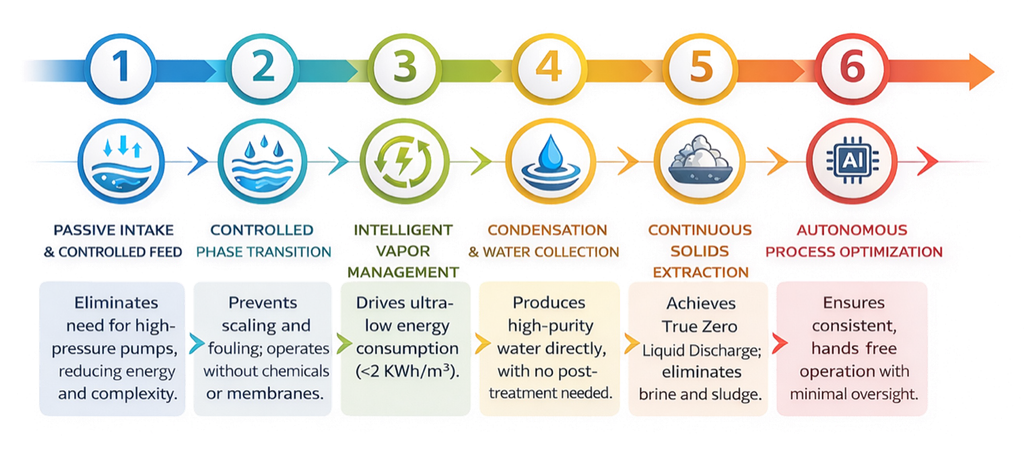
DEVA operates through a six-stage integrated process: passive intake and controlled feed, controlled phase transition, intelligent vapor management, condensation and water collection, continuous solids extraction, and autonomous process optimization. This integrated approach is designed to minimize mechanical and chemical requirements, control scaling and fouling, recover high-purity water, continuously remove concentrated solids, and enable automated operation through intelligent process control and real-time monitoring.
deva technology features
True zero liquid discharge (zld)
All incoming water is fully processed, eliminating brine and liquid waste streams entirely, a true zero-discharge environments.
Pure Water Delivery
Recovers nearly all usable water from the feed stream, transforming challenging sources into reliable, high-quality water supply.
total resource recovery
Dissolved materials are extracted as stable, recoverable solids, converting what is traditionally waste into usable by-products.
low electrical energy demand
Exceptionally low net electrical power requirements, enabling energy efficient operation without reliance on external heat sources.
chemical-free operation
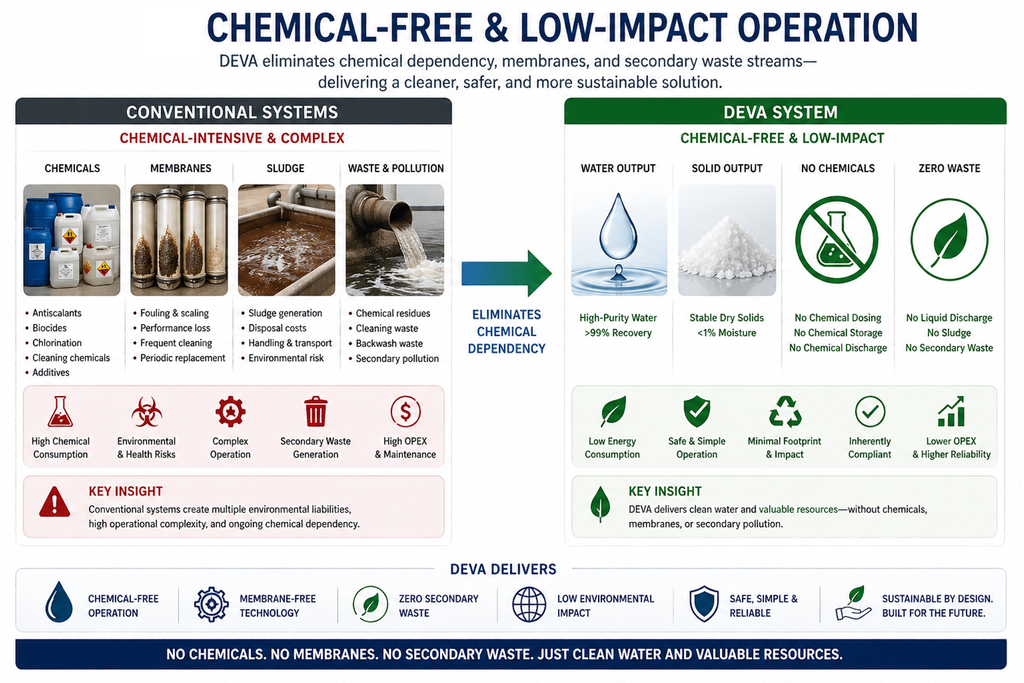
No chemicals are required at any stage, eliminating dosing systems, storage, handling risks, and chemical supply dependencies.

membrane-free technology
Eliminates membranes entirely, avoiding fouling, replacement cycles, performance degradation, and lifecycle complexity.
modular & scalable architecture
Standardized modules allow flexible system sizing, phased expansion, and deployment across centralized or distributed installations.
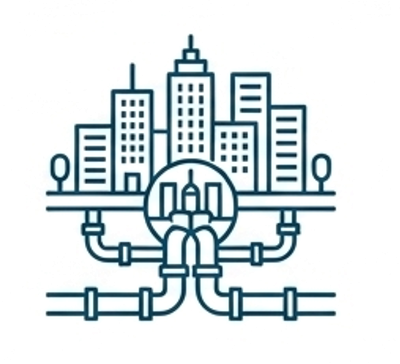
large-scale plants
Large-scale plant deployments for municipal desalination grids and major metropolitan water authorities.
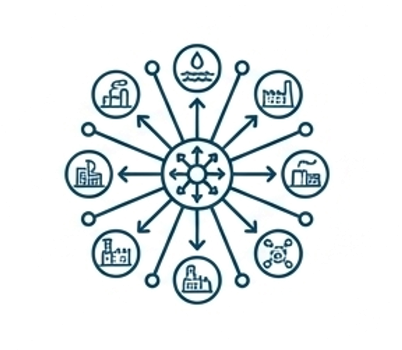
distributed architecture
Localized water networks and point-of-source industrial facility treatment, eliminating the need for long-distance wastewater transport.

operational intelligence
Autonomous optimization intelligent deep vacuum separation closed-loop thermodynamics autonomous process controlled phase transition.
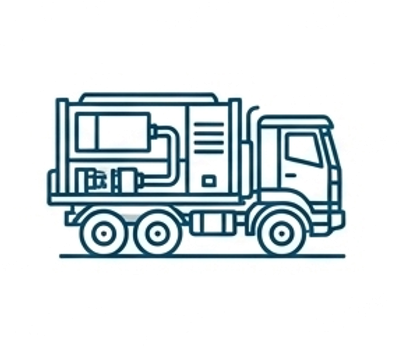
mobile truck & vessel
Truck or vessel-based rapid deployment for off-grid
applications, disaster emergency response, and remote mining/energy fields.
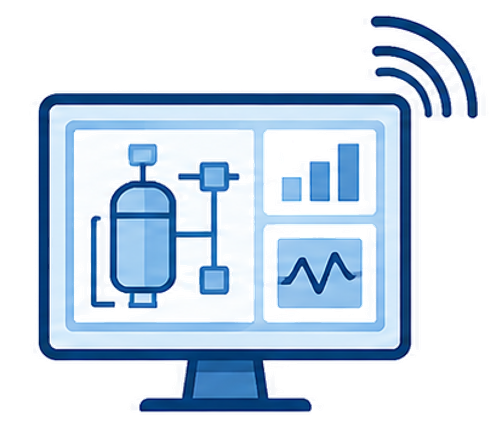
intelligence operation
Intelligent management, continuous solids extraction, real-time PLC/SCADA monitoring, data collections, and water quality test.
technology breakthrough
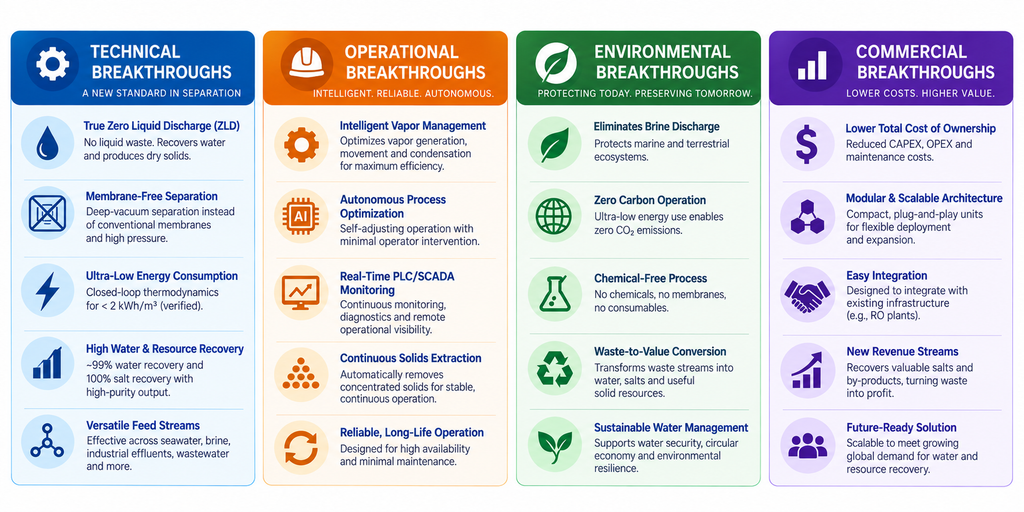
Technical Breakthroughs deliver membrane-free deep-vacuum separation, True Zero Liquid Discharge (ZLD), ultra-low energy consumption, and high water and resource recovery
Operational Breakthroughs integrate intelligent vapor management, autonomous process optimization, continuous solids extraction, and real-time PLC/SCADA monitoring for reliable and efficient operation;
Environmental Breakthroughs eliminate liquid brine discharge while reducing the need for chemicals, membranes, and consumables and enabling waste-to-value resource recovery
Commercial Breakthroughs provide a modular and scalable platform designed to reduce total cost of ownership, simplify integration with existing infrastructure, minimize disposal and maintenance requirements, and create opportunities to recover valuable resources from challenging waste streams.
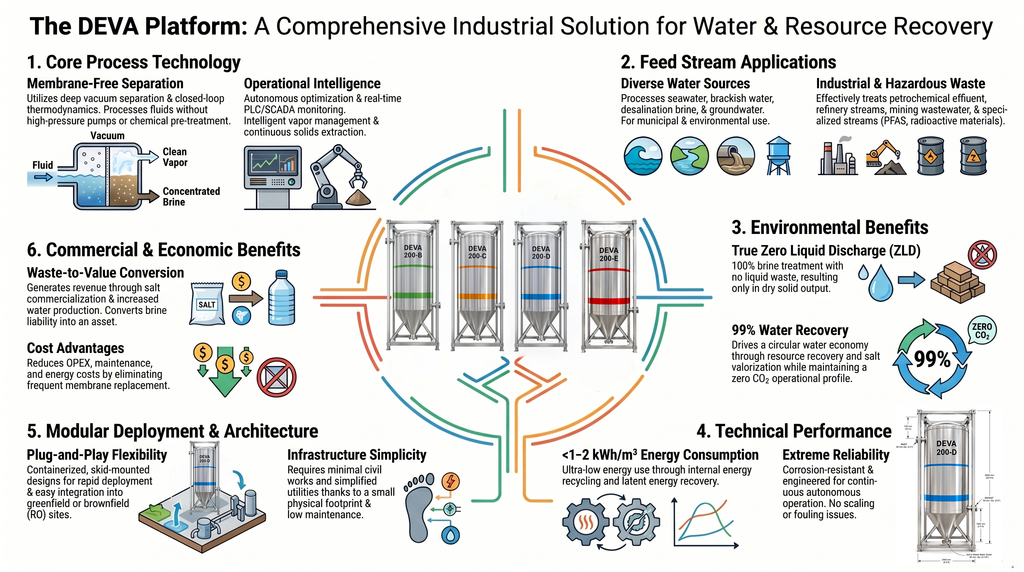
THE DEVA PLATFORM
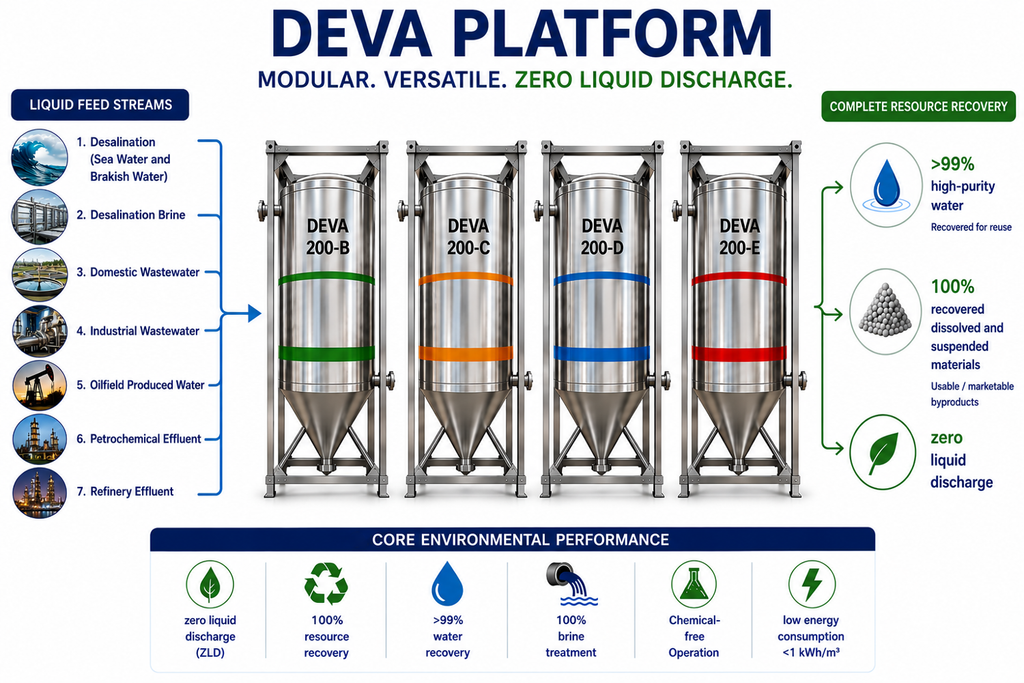
DEVA is a comprehensive industrial platform for water treatment, resource recovery, and waste minimization, combining membrane-free separation with operational intelligence and modular deployment.
The platform is designed to process diverse feed streams including seawater, brackish water, groundwater, desalination brine, industrial and hazardous waste streams, while enabling high water recovery and conversion of concentrated waste into potentially valuable solid resources. Its integrated architecture incorporates deep-vacuum separation, closed-loop thermodynamics, autonomous optimization, intelligent vapor management, continuous solids extraction, and real-time PLC/SCADA monitoring. With a modular, plug-and-play design, DEVA is intended to simplify installation and integration while reducing infrastructure requirements, maintenance and operating costs. The platform is positioned to support True Zero Liquid Discharge (ZLD), resource recovery, lower energy consumption, and waste-to-value applications across municipal, industrial, environmental, oil & gas, and specialized treatment sectors.
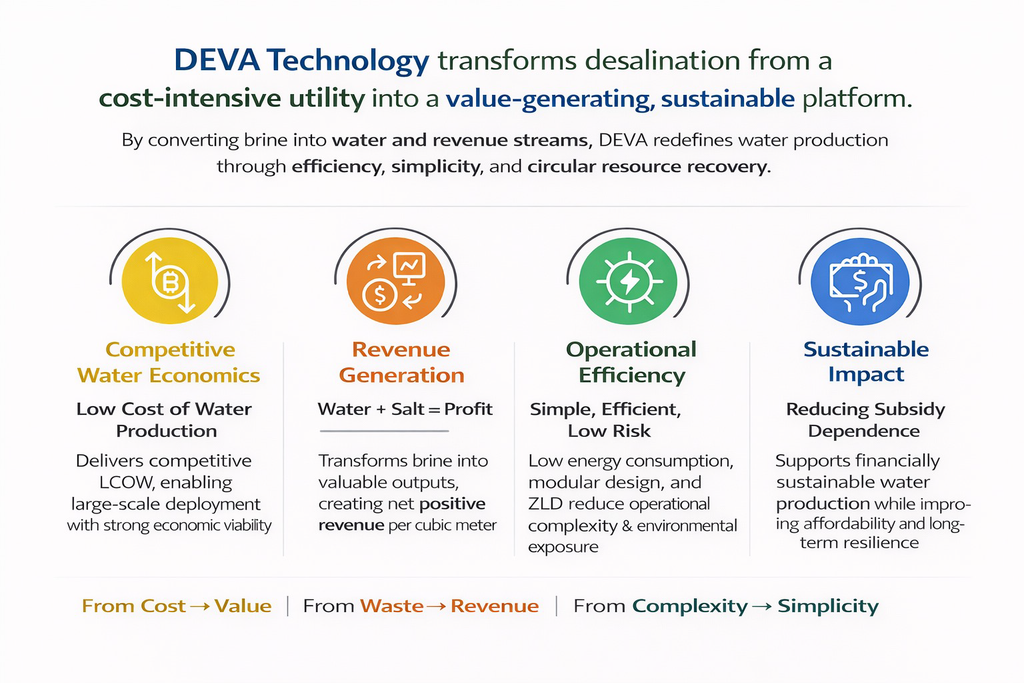
deva economic & sustainability value
DEVA Technology transforms desalination from a cost-intensive utility into a value-generating and sustainable platform. By converting brine from a disposal challenge into recovered water and potentially valuable salt resources, DEVA creates a fundamentally different economic model for water production. Its approach is designed to support competitive water production costs, new revenue generation, operational efficiency, and sustainable impact. Through low-energy operation, modular architecture, simplified processes, and Zero Liquid Discharge, DEVA can reduce operational complexity and environmental exposure while improving the overall economics of desalination.
Shift from cost to value, from waste to revenue, and from complexity to simplicity.
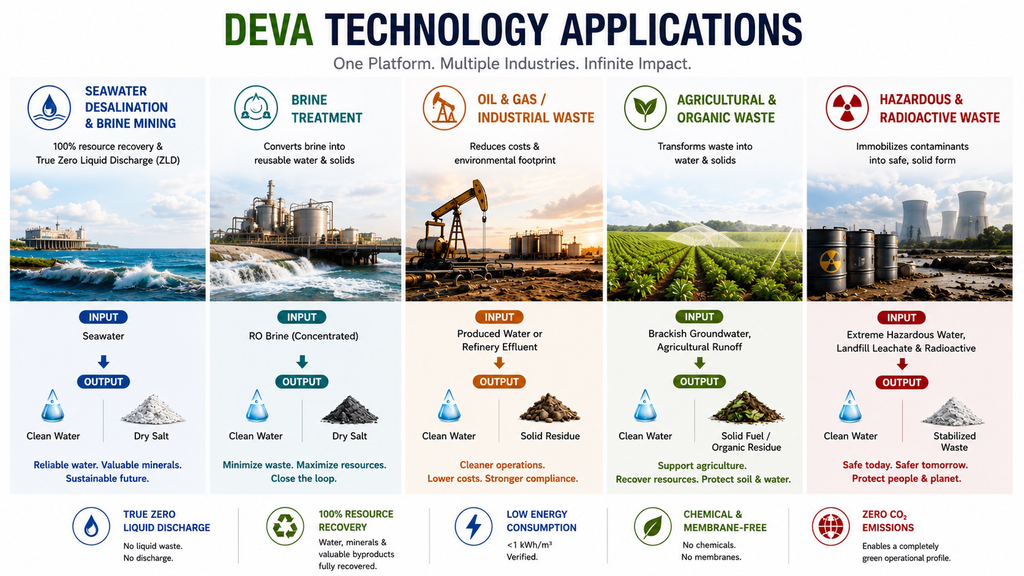
DEVA Applications
DEVA is a versatile water and waste-treatment platform applicable across seawater desalination and brine mining, industrial and oil & gas wastewater, agricultural and organic waste, and hazardous or radioactive waste treatment. The technology is designed to recover clean water, valuable salts and other usable resources while reducing waste, discharge and environmental impact. Its applications support True Zero Liquid Discharge (ZLD), high resource recovery, low energy consumption, and chemical- and membrane-free operation, enabling more efficient, sustainable and cost-effective treatment across diverse industrial and environmental applications.
DEVA head to head vs. traditional desalination technologies
DEVA introduces a fundamentally different approach to desalination and brine management by focusing on value, impact, and efficiency rather than water production alone. While traditional desalination technologies typically rely on membrane-based separation, high-pressure pumping, and downstream brine management, DEVA is designed around membrane-free deep-vacuum separation, closed-loop thermodynamics, high water recovery, and continuous solids extraction.
This approach is intended to reduce energy and operational complexity while addressing the challenge of liquid brine disposal through True Zero Liquid Discharge (ZLD) and resource recovery. Economically, DEVA seeks to move beyond the conventional water-as-a-cost model by creating opportunities to recover salt and other valuable resources from concentrated streams, potentially generating additional value alongside water production.
The result is a technology proposition centered on greater resource utilization, reduced waste, simplified operations, and improved overall project economics.
| DEVA Technology | Traditional Solutions | |
| Technology | Deep Vacuum Evaporation (DVE): Evaporation of water at low temperatures under controlled low internal atmospheric pressure. | Reverse Osmosis (RO) Multi-Stage Flash Distillation (MSF) Multi-Effect Distillation (MED) |
| Water Recovery Rate | ~99% recovery of all incoming feed water. Stable system efficiency over operational lifetime. | Less than 50% of incoming water is recovered. Efficiency decreases as membranes and systems degrade and depreciate. |
| Net Energy Consumption | Evaporation and salt separation internally consume < 1 kWh per cubic meter of water. Overall net consumption of <2 kWh per cubic meter of water, including salt collection systems. | High energy consumption, especially with MSF and MED, reaching up to 15 kWh per cubic meter. Heavy reliance on thermal energy sources from burning fossil fuels. Increased power consumption per cubic meter of water over time as membranes and systems degrade. |
| Support Systems and Infrastructure Requirements | Direct implementation on a simple infrastructure. No need for high-pressure pumps, pre- or post- treatment systems, or chemical handling stations. Independent desalination plants, separate from power generation facilities. | Require complex infrastructure, including multiple pre-treatment and post-treatment stages. Need chemical handling stations and mechanical filtration systems. Traditionally built as part of large power generation plants to utilize steam generated from cooling systems. |
| Operations and Maintenance | Automated system operation without auxiliary support systems. Simple maintenance processes, mostly on storage, distribution, and salt collection systems. Continuous, uninterrupted operation (24/7/365). Centralized monitoring systems control production water quality. | Complex, segmented operation with multiple consecutive stages, including filtration, pretreatment, and post-treatment stages. Require separate auxiliary systems such as chemical handling stations and mechanical filters. Frequent downtime for replacing filters and membranes, and maintenance of auxiliary support systems. |
| Application Flexibility | Modular design offering high flexibility and Simple scalability. Easy to increase capacity by adding more units. Capacity per unit: 200 m/day. Compact footprint: total area of one unit = 21m2, including clearances. Requires less than 15% of land space compared to traditional solutions. Desalination operations can start within months of project initiation. | Rigid design does not allow for gradual capacity increase. Fixed production capacity that cannot be easily scaled. Cannot start partial desalination without completing the entire infrastructure and auxiliary systems, which takes several years. Require large land areas, often located outside populated centers, to minimize the impact of pollution. Increased water distribution costs due to distance from demand centers. |
| Byproducts and Environmental Impact | Produces solid salts with no liquid brine discharge. No harmful waste released into marine or terrestrial environments. No greenhouse gas emissions from operation. | Produce highly concentrated brine, usually discharged into the sea, causing significant harm to marine and coastal ecosystems. Emit greenhouse gases from fossil fuel use in thermal desalination systems. |
| Levelized Cost of Water (LCOW) | Competitive LCOW when compared to Reverse Osmosis systems. Salt/Brine recovery returns profit per cubic meter. | High water production cost, especially when using multi- stage systems. |
| Applications Diversity | DEVA technology can be used to recover water from the brine discharged from traditional desalination solutions, which doubles the production capacity of existing desalination plants while reducing hybrid facility LCOW. DEVA technology can be used in several applications for treating wastewater, purifying well water, and treating industrial and petrochemical effluents. | These systems have proven inefficient in water purification applications other than seawater desalination, taking into account the high costs and the negative environmental impacts of these solutions. |
Government Subsidies | Eliminates the need for subsidies and transforms the sector into profitability. | Government subsidies are necessary to offset high production costs. |
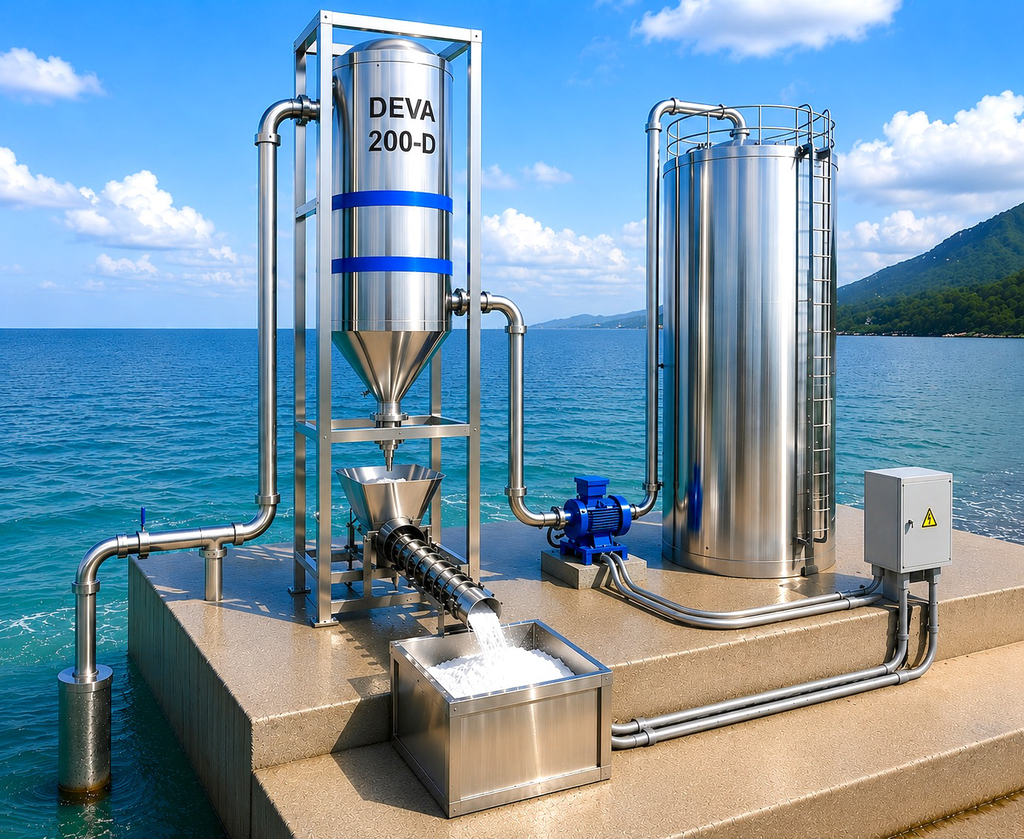
DEVA seawater greenfield & brownfield
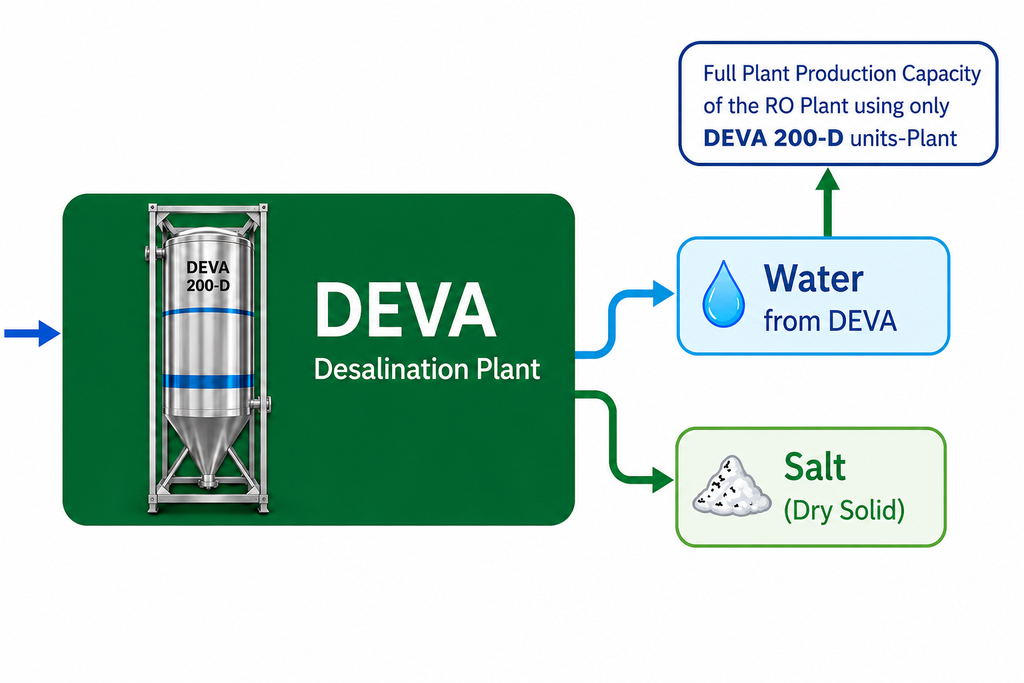
Greenfield Projects (New Builds):
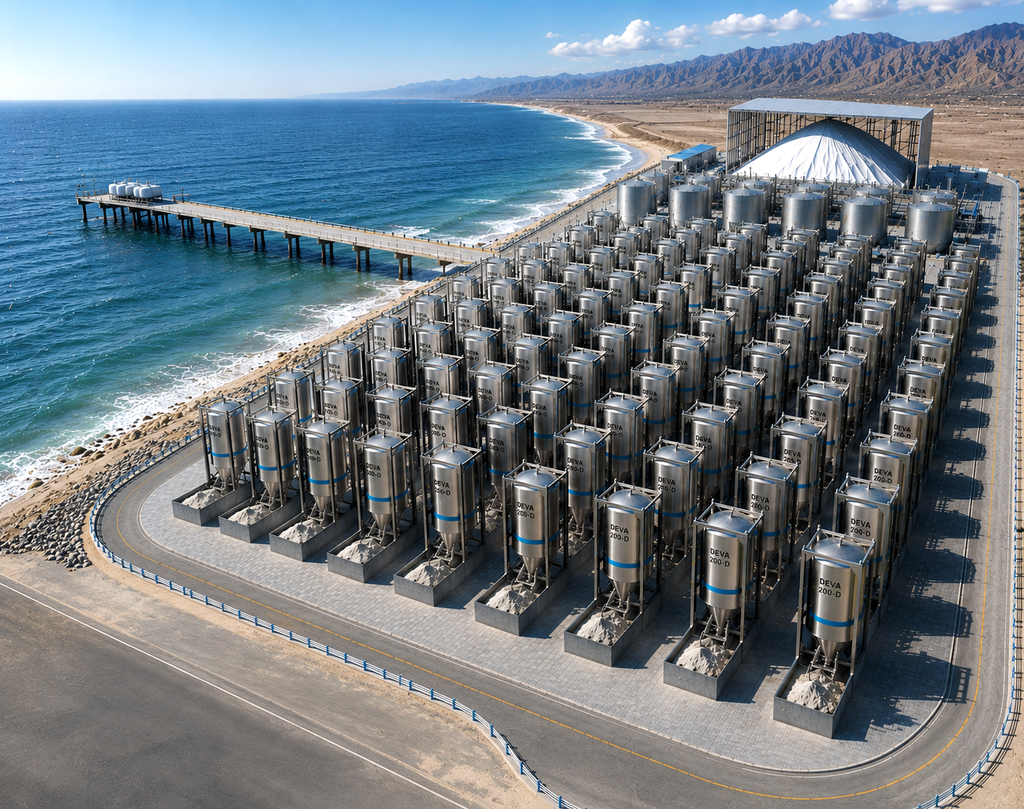
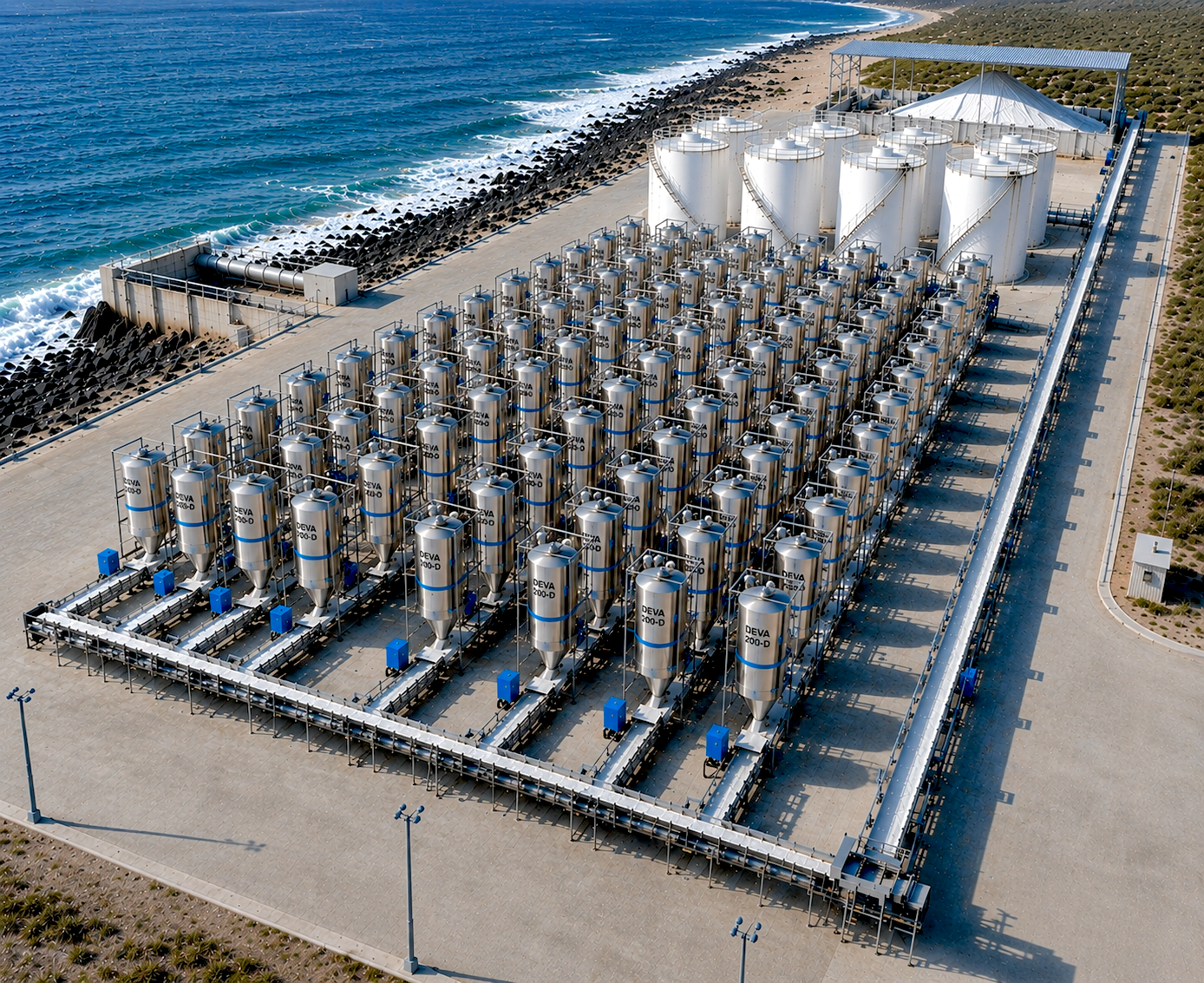
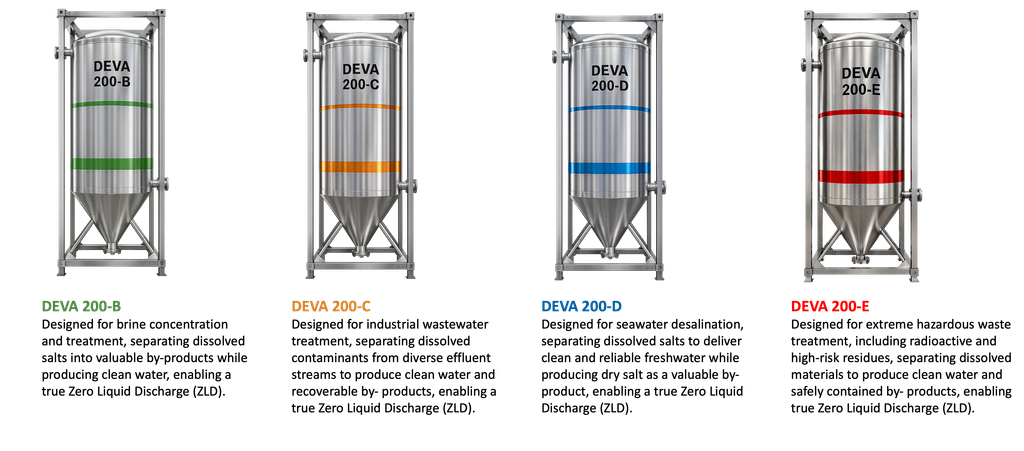
The DEVA 200-D Desalination System is the ideal standalone solution for new plants. It achieves ~99% water recovery from seawater, producing pure water and dry, technical-grade salt with zero liquid discharge.
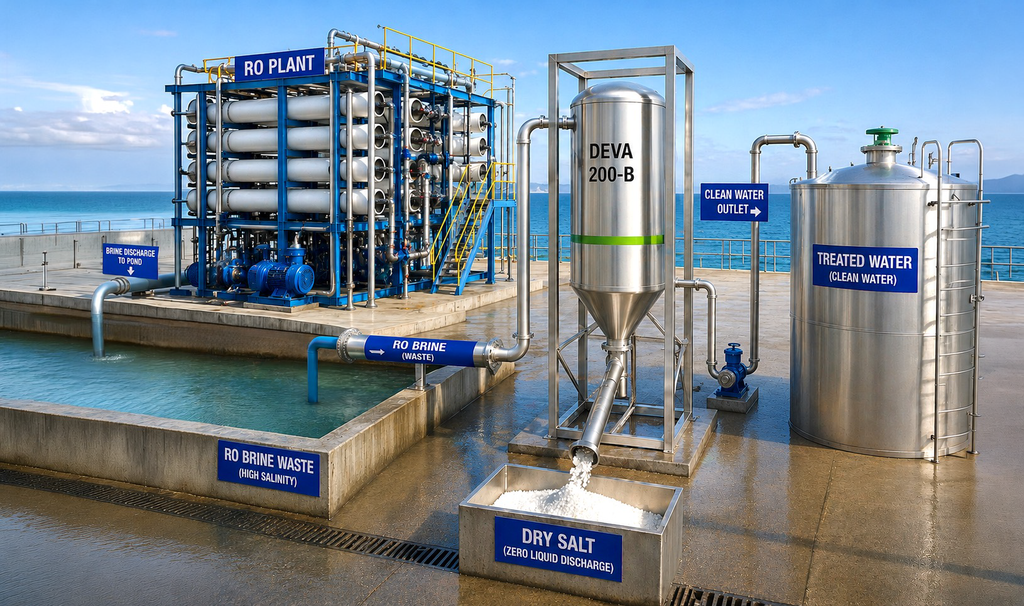
Brownfield Projects (connect to existing RO Plants)
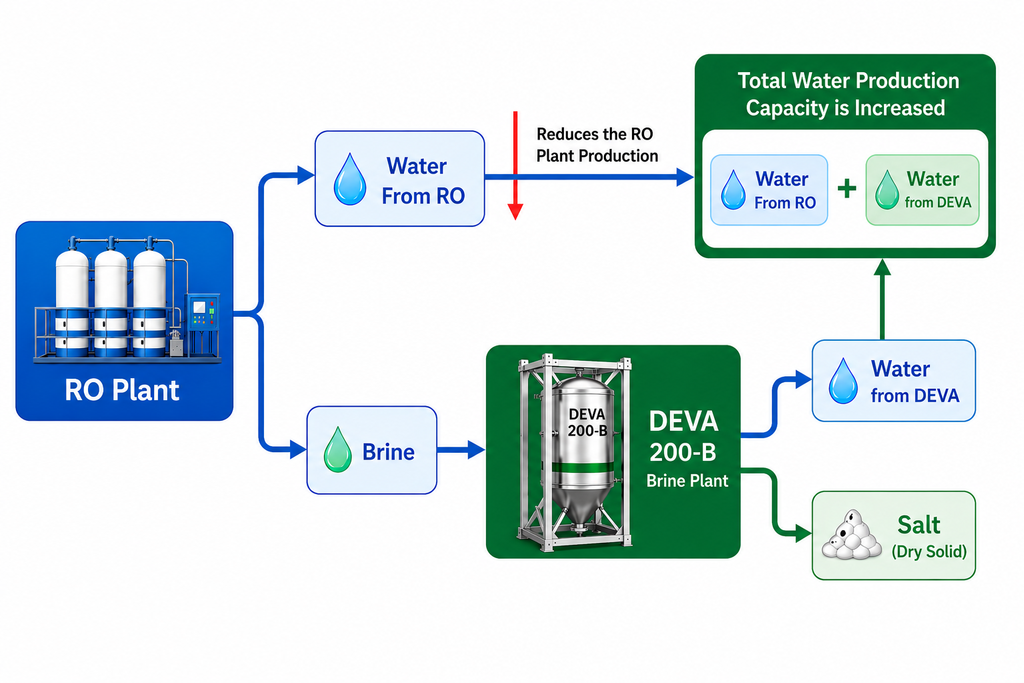
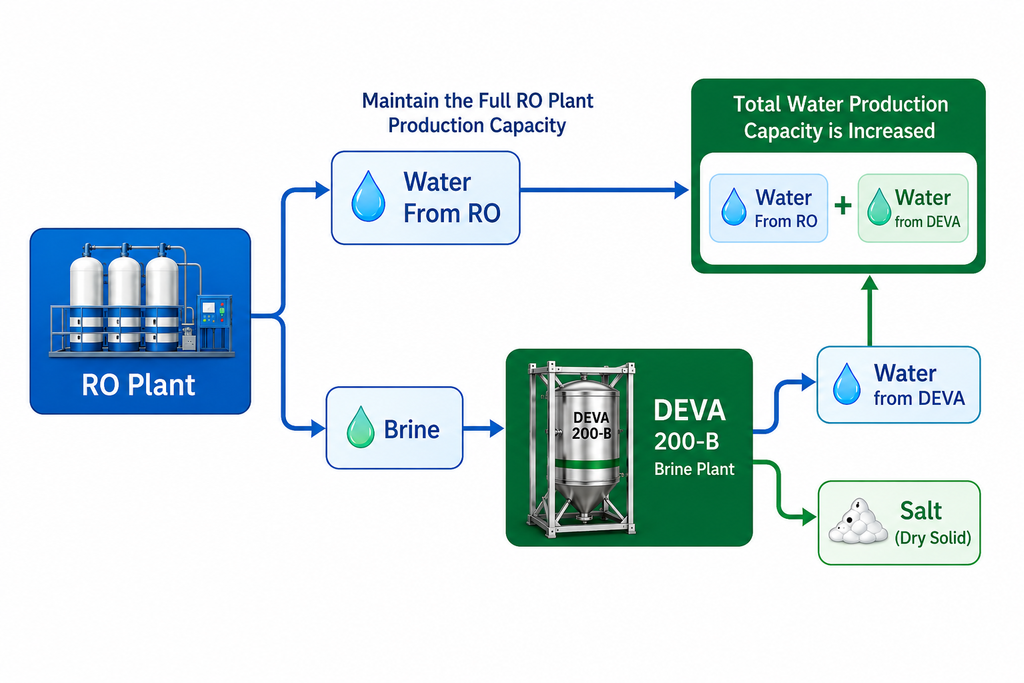
The DEVA 200-B seamlessly complements existing RO operations by processing its waste brine. This compensation transforms a costly waste stream into a valuable source of additional fresh water and revenue-generating technical salts, dramatically enhancing the ROI, sustainability of the entire plant, and directly contributing to extending the operational life of an RO plant.
DEVA strategic implementation Scenarios
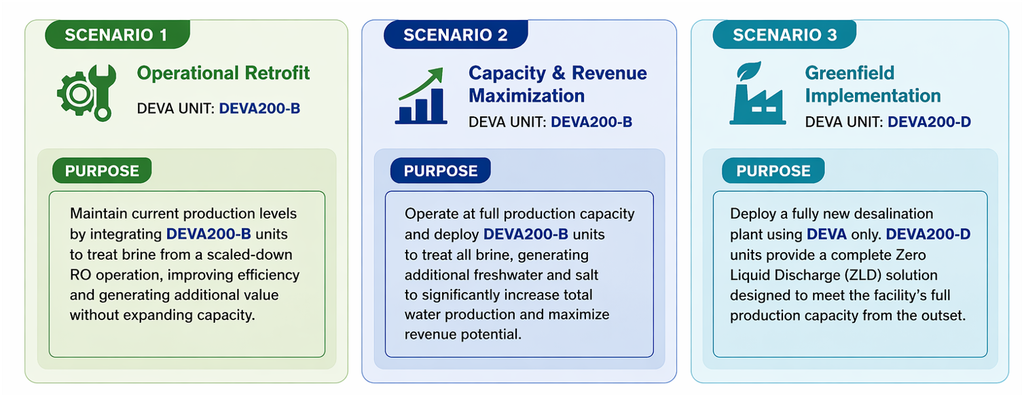
DEVA can be deployed through three strategic implementation scenarios, depending on the objectives and existing infrastructure of the project.
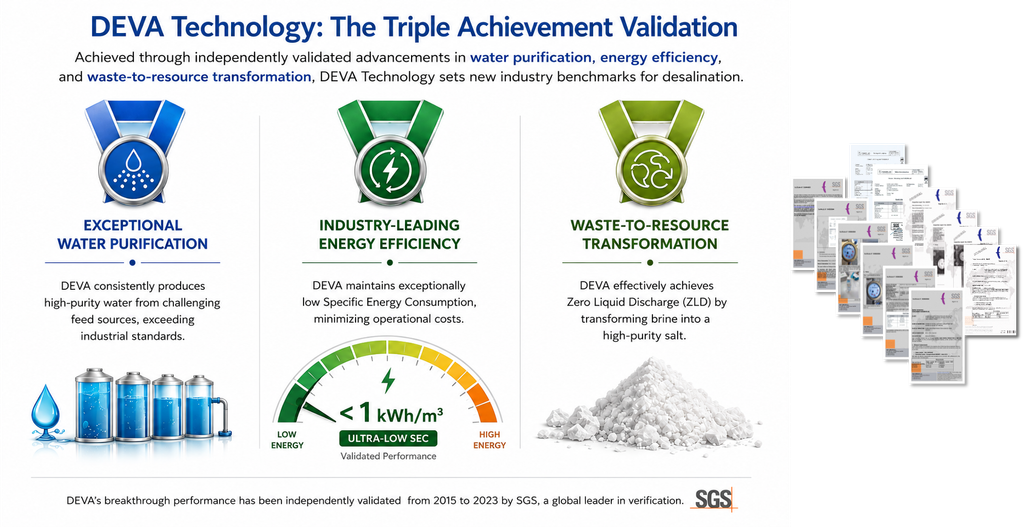
proven performance & validation
High-level technical specifications
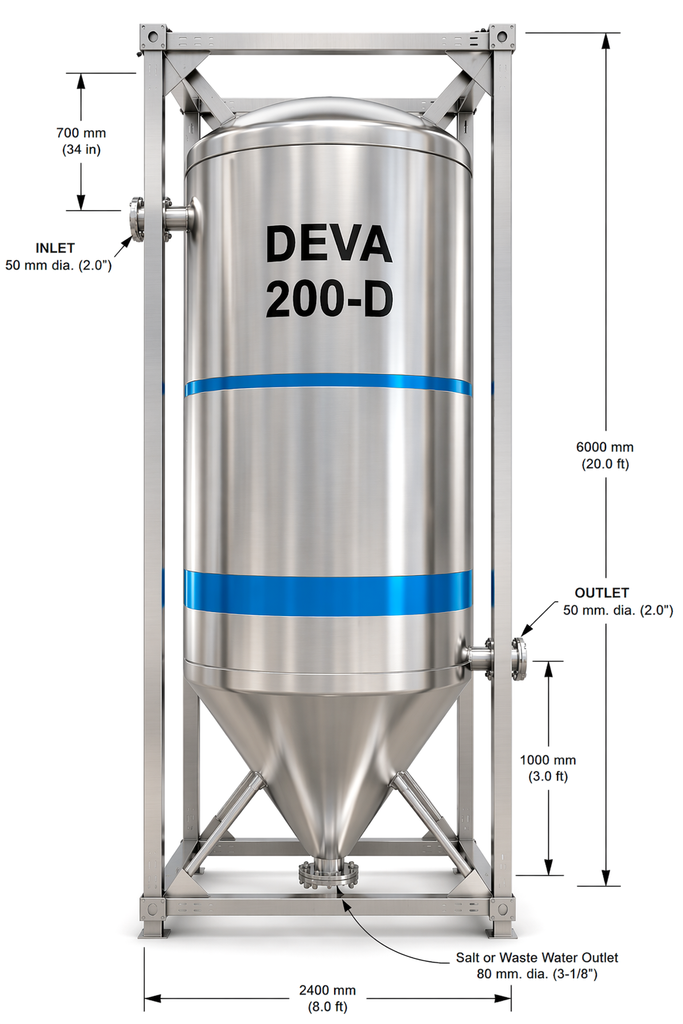
- Production Capacity: 200 m3 of clean water per day.
- Dimensions: 2.44 m (L) × 2.59 m (W) × 6.0 m (H).
- Weight: 5 – 10 tons (configuration dependent).
- Ambient Temperature: -10°C to +50°C (extensions available for extreme heat up to 70°C, or extreme cold with insulation).
- Humidity: Up to 95% Relative Humidity.
- Altitude: Up to 2000 m above sea level without performance loss; higher altitudes may require adjustments for vacuum efficiency.
Environmental Operating Range: The unit is designed for 24/7/365 operation in ambient conditions typical of regions like the Middle East. - Permitting & Compliance: The unit complies with international standards including CE marking for EU safety and can be configured for ATEX certification (Zone for hazardous areas involving chemicals like acids. Additional certifications (e.g., IECEx for global markets)
are available upon request to simplify client permitting
processes. All documentation, including risk assessments
and conformity declarations, will be provided to support
local regulatory compliance.
contact us